


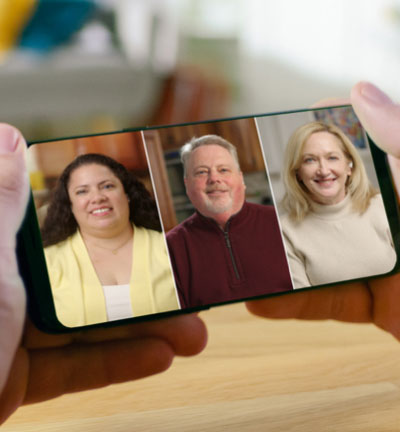



Get inspired to self-advocate with real MG treatment stories from the community.
No myasthenia gravis (MG) treatment journey is the same—it’s as unique as you are. And, while you can’t compare yourself to others, it may be uplifting and inspiring to hear the stories and experiences from fellow members of the MG community. Read on, as two people living with MG share their personal experiences navigating treatment through collaboration with their healthcare teams and self-advocacy.
Tom* loved to play sports. But when he realized something wasn’t quite right while competing in a tennis tournament, he went to his doctor. “I had never heard of MG when I was eventually diagnosed with it,” says Tom. “At that time, it felt like I didn’t have many treatment options.”
Alternatively, Caitlin* was finishing up nursing school when she was diagnosed with MG. She shares, “In 2020, during the COVID-19 pandemic, I received my diagnosis. While it was a time of uncertainty,” she says, “there were a lot of MG treatment options available that I felt equipped to handle whatever came next.”


 Tom, living with MG
Despite different initial experiences, both Tom and Caitlin faced various ups and downs before landing on their current treatment plans. Whether it’s an insurance change or a need to adjust your treatment plan, navigating the MG treatment journey can sometimes feel challenging. “I’ve tried several treatments before I got to the treatment plan that I’m on now,” shares Tom. Caitlin adds that it doesn’t feel good when a treatment doesn’t work: “When it first happened to me, I definitely allowed myself to feel all the emotions that came with it.” But even though she initially felt down and frustrated, Caitlin was motivated.
I knew that I had to keep looking and that I couldn’t just stop there. I was really driven to get to a point where I was feeling better.
Work with your healthcare team
It’s important to trust your healthcare team and have honest conversations with them. This not only helps facilitate a strong doctor partnership, but it also helps you gain the confidence to advocate for yourself. “Whenever I tell my neurologist I don’t think my medication is working,” says Tom, “her reaction is, ‘Let’s go back and see what we can do.’” Caitlin agrees, “If a treatment didn’t work, my doctor shared other options with me. I knew they were going to advocate for me. So, if one treatment doesn’t work, it’s more like, ‘OK, what’s next?’”

 Caitlin, living with MG
Doctors’ appointments can go by fast with a lot of important material to cover. You may go in with topics you want to discuss and forget them once you’re there. Feel empowered to bring notes to discuss at appointments and to use your patient portal if you do forget to discuss anything. You can also use this handy discussion guide for talking to your healthcare team about MG.
It may also be helpful to talk to your doctor about what to expect from a certain treatment plan so that both of you are on the same page. Don’t be shy to ask about your options either, even if you’re not sure where to start—your doctor is there to help you figure it out.
The evolving treatment landscape
As the treatment landscape changes, feeling comfortable asking questions and chatting through options with your healthcare provider may be beneficial and empowering. This educational overview of common MG treatments may help provide information on the treatment options available. Consider the differences among these options and the role they could play in your treatment plan. One treatment type that is part of the MG treatment landscape is biologic therapy. Biologic therapies have been used for decades to treat other conditions, and there are two subtypes that are approved for various types of generalized MG (gMG). Remember to always ask your doctor about whether a treatment could be right for you.
Tracking your MG symptoms
When Tom starts a different treatment, he pays attention to his day-to-day activities. Also, he takes notes of things such as his level of fatigue or his ability to walk or climb stairs.
The Myasthenia Gravis Activities of Daily Living (MG-ADL) scale is one way to track MG symptoms. It’s made up of eight questions about daily activities. Using symptom-tracking tools can help you and your healthcare team develop an MG treatment plan that works for you.
Your MG treatment journey may come with ups and downs. However, tracking your symptoms and partnering with your healthcare team may help you better navigate it to get on a treatment plan that works for you—and to aim for a greater everyday with MG.
Speak with your doctor to learn more, and download the MG management discussion guide for questions to ask at your next appointment.





 Facebook
 X
X Pinterest
